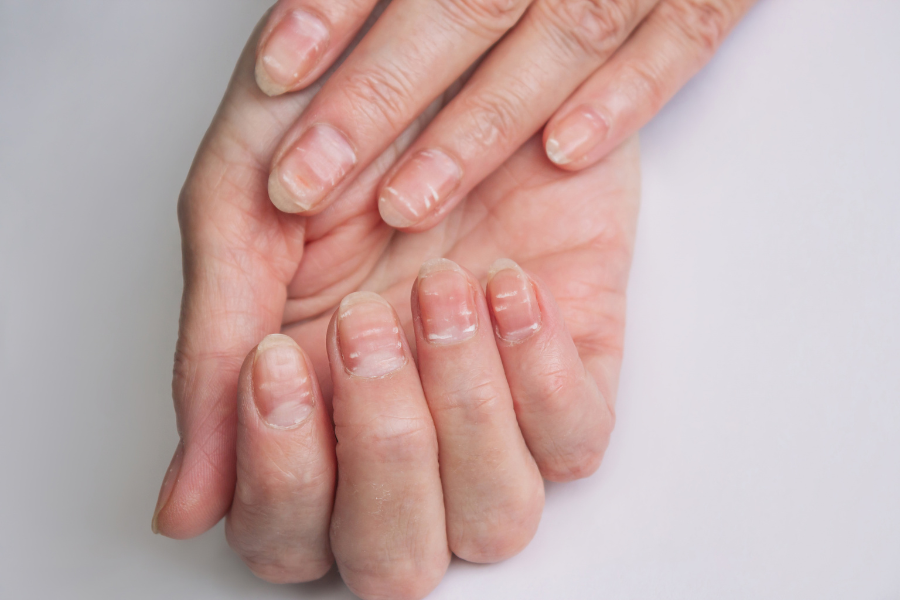


Your fingernails are talking to you. A pale nail bed, a spoon-shaped dip, or a strange dark streak can all be early warnings that your body is running low on something it needs. Most people brush these changes off as dryness or bad nail polish. But nail changes are often one of the first visible clues that your body isn’t getting enough vitamin B12 or iron.
In this guide, you’ll learn how to recognize the specific nail signs linked to B12 and iron deficiency. You’ll also find out which blood tests confirm a diagnosis, what treatment actually looks like, and how to prevent these deficiencies through diet. Let’s start with why your nails are so sensitive to what’s happening inside your body.
How B12 and Iron Deficiency Affect Nail Health and Structure
The Science of Nail Growth: Matrix, Keratin, and Oxygen Delivery
Your nails are made mostly of keratin, a tough structural protein, along with lipids, minerals, and water. New nail cells are produced in the nail matrix, a small strip of tissue tucked just beneath the base of your nail. This is where growth actually happens.
Iron plays a direct role in that process. It’s a key building block of hemoglobin, the protein that carries oxygen through your blood. When iron levels fall, oxygen delivery to the nail matrix drops, and keratin production slows down as a result.
Vitamin B12 works differently but is just as essential. It’s needed for DNA synthesis, which drives the rapid cell division happening constantly in the nail matrix. Without enough B12, new nail cells can’t form properly, and the nail plate that grows out often looks thinner or oddly textured.
Why Coexisting Deficiencies Impede Nail Quality
B12 and iron deficiencies often show up together, especially in people with digestive conditions, chronic gut disorders, or a vegetarian or vegan diet. When your gut struggles to absorb nutrients, it usually struggles to absorb more than one at a time.
Folate deficiency frequently travels alongside low B12. Both nutrients are involved in cell division, so when they’re both low, nail problems tend to be more pronounced and slower to resolve. If your nails aren’t improving despite treatment, ask your GP to check folate levels too.
Recognizing the Signs of B12 and Iron Deficiency in Nails
Warning Signs of Iron Deficiency
Iron deficiency tends to produce a fairly recognizable pattern of nail changes. Here’s what to look for:
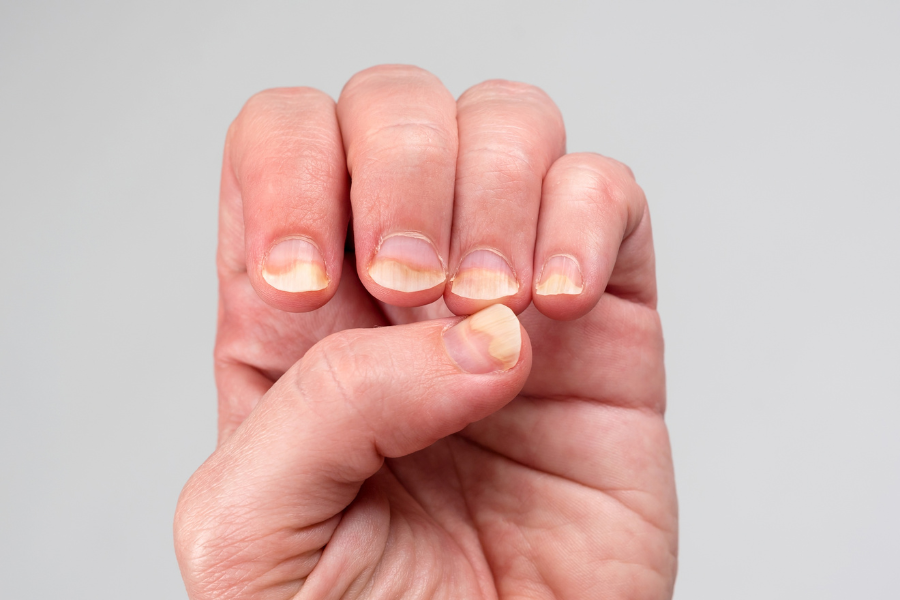
- Koilonychia (spoon-shaped nails): The nail plate becomes thin and soft, curving upward at the edges until it looks scooped out, sometimes deep enough to hold a drop of water. This is one of the most classic signs of iron-deficiency anemia, described as a nail that develops raised ridges and curves inward as it thins.
- Brittle texture: Nails become fragile, peel in layers, split, or break easily.
- Nail bed pallor: The pink tone underneath the nail turns pale or white, reflecting reduced blood oxygen.
- Slow growth: Nails that normally grow about 3mm a month may slow down noticeably when iron stores run low.
These nail changes rarely show up alone. The NHS notes that iron deficiency anaemia is caused by a lack of iron, often linked to blood loss or pregnancy, and other common symptoms include tiredness, shortness of breath, noticeable heartbeats, paler than usual skin, and headaches. According to the NHS’s less common symptom list, tinnitus, food tasting strange, itchy skin, a sore tongue, hair loss, cravings for non-food items like ice or paper, and restless legs syndrome can also appear alongside nail changes. If you notice several of these together, it’s worth mentioning all of them to your GP, since the fuller picture makes diagnosis faster.
Signs of Vitamin B12 Deficiency in Nails
B12-related nail changes look quite different from iron-related ones, and they’re often mistaken for something else entirely.
- Blue-grey or brown hyperpigmentation: A diffuse darkening spreads across the nail plate.
- Longitudinal melanonychia: Dark vertical bands run from the cuticle to the nail tip. This shows up more often in people with darker skin tones. One case report in the Indian Dermatology Online Journal described a child with blackening across multiple fingernails and toenails who followed a strict vegetarian diet, along with increased pigmentation on the knuckles and bony areas.
- Nail plate thinning: Nails become visibly thinner as impaired cell division limits how well the nail plate can rebuild itself.
Researchers believe the pigmentation happens because B12 helps maintain glutathione, a compound that normally keeps melanin-producing enzymes in check. A dermatology review published in the Thai Journal of Dermatology explains that when B12 runs low, this regulation breaks down and pigment-producing activity increases in the nail matrix and surrounding skin. The encouraging part: this kind of pigmentation is usually reversible once B12 levels are corrected.
Other Nail Changes and Nutrient Deficiencies to Keep in Mind
Not every nail change points to B12 or iron. Here’s a quick guide to some lookalike symptoms:
- Vertical ridges: Common with aging and dehydration, but can also relate to iron, biotin, or zinc deficiency.
- Horizontal ridges (Beau’s lines): Deep grooves that usually follow an illness, surgery, or serious nutritional gap. They’re linked to low protein, zinc, iron, calcium, or vitamin C.
- White spots (leukonychia): Usually caused by minor trauma to the nail matrix, though transverse white lines occasionally point to short-term shortfalls in zinc, calcium, or B vitamins.
Urgent Red Flag Symptoms
Most nail changes tied to nutrient deficiency are gradual and reversible. But a few signs need medical attention right away.
A new or changing dark band on a single nail should be checked by your GP promptly, since this can occasionally indicate subungual melanoma rather than a nutrient issue. This matters because melanonychia caused by B12 deficiency usually shows up on multiple nails at once, while a melanoma-related band typically affects just one nail and can widen or darken over time. Seek urgent medical care if nail changes appear alongside severe breathlessness, chest pain, or fainting, since these point to a more advanced level of anemia that needs prompt evaluation.
Diagnostic Testing for B12 and Iron Deficiencies
Nail changes are a clue, not a diagnosis. Confirming a deficiency requires blood testing, which your GP will usually order as a first step.
Essential Blood Tests for Iron Status
The NHS explains that a full blood count (FBC) test is the usual starting point, checking whether your red blood cell count falls within a normal range. Beyond the FBC, a few other markers help confirm iron deficiency:
- Serum ferritin: Levels below 15 µg/L strongly indicate deficiency, while 15–30 µg/L suggests a possible deficiency. Some newer research argues this threshold may actually be set too low — a large 2024 primary care study found that raising the ferritin cutoff to 30 or 45 ng/mL identified substantially more cases of both nonanemic and anemic iron deficiency compared with the traditional 15 ng/mL cutoff.
- C-reactive protein (CRP): Because inflammation can artificially raise ferritin, CRP helps rule out a false-normal reading.
- Transferrin saturation: A result below 20% supports a diagnosis of iron deficiency.
Blood Tests for B12 and Folate Status
Serum B12 testing typically flags levels below 148 pmol/L as deficient, with 148–258 pmol/L considered a borderline or possible deficiency. When results are unclear, your GP may order additional tests like holotranscobalamin or red cell folate for a fuller picture.
Identifying the Underlying Causes of Malabsorption
Once a deficiency is confirmed, the next step is figuring out why. The NHS points out that pernicious anaemia, an autoimmune condition affecting the stomach, is the most common cause of vitamin B12 deficiency in the UK, since B12 needs to combine with a stomach protein called intrinsic factor to be absorbed. Your GP may test for intrinsic factor antibodies, check for coeliac disease, or refer you for an endoscopy to rule out gastrointestinal blood loss.
Certain medications can also interfere with absorption. Long-term use of acid-reducing drugs like proton pump inhibitors, as well as some anticonvulsants and the diabetes medication metformin, can all lower B12 levels over time. If you take any of these regularly, it’s worth flagging that to your GP alongside your nail symptoms.
Medical Treatment for B12 and Iron Deficiency Nail Problems
Correcting Iron Levels with Oral and Intravenous Therapy
Oral iron is the standard first-line treatment. According to pharmacy guidance, ferrous sulfate is widely used to treat or prevent iron deficiency anaemia by helping replenish the iron your body needs to make haemoglobin. A typical dose is ferrous sulphate 200mg, and some clinicians prescribe it on alternate days rather than daily, since spacing doses out can reduce side effects while still improving absorption.
A few practical tips make a real difference:
- Take iron tablets on an empty stomach when possible.
- Avoid tea, coffee, milk, or antacids within one to two hours of your dose, since these block absorption.
- Pair your tablet with a source of vitamin C, like orange juice, to boost uptake. The NHS specifically recommends drinking orange juice after taking an iron tablet to help your body absorb the iron.
Side effects like nausea, constipation, or darker stools are common but usually manageable. The NHS also notes you’ll typically need to take iron tablets for about six months, and it’s important to keep taking them even if mild side effects appear. Intravenous iron is reserved for severe cases, malabsorption, or when oral iron isn’t tolerated.
Restoring Vitamin B12 Levels
In the UK, B12 deficiency is usually treated with intramuscular injections. Per the NHS treatment page, vitamin B12 deficiency anaemia is usually treated with hydroxocobalamin injections, given every other day for two weeks or until symptoms start improving. After that loading phase, your GP will adjust the schedule depending on whether the cause is diet-related or linked to pernicious anaemia, with maintenance injections often continuing every two to three months for people with pernicious anaemia.
People with a diet-related deficiency, rather than an absorption problem, may instead be prescribed high-dose oral cyanocobalamin, typically in the range of 1,000 to 2,000 micrograms daily.
Supportive Nail Care During Recovery
While your levels recover, a few habits can protect your nails from further damage:
- Keep nails trimmed short to reduce breakage.
- Avoid harsh chemicals, prolonged water exposure, and acetone-based nail polish removers.
- Moisturize your cuticles regularly and wear gloves for household chores.
The Realistic Timeline for Nail Recovery
Nail recovery takes patience. It generally takes four to six months for a fingernail to grow completely from base to tip, and six to twelve months for the shape or texture to fully return to normal. Blood levels usually improve well before your nails catch up, so don’t be discouraged if your nails still look off even after your bloodwork looks better.
Dietary Prevention of Deficiency-Related Nail Damage
Dietary Sources of Highly Bioavailable Iron
Not all dietary iron is absorbed equally. Heme iron, found in animal foods, is absorbed at a rate of roughly 15–35%, making it far more efficient than plant-based iron.
Heme iron sources: red meat, poultry, fish, seafood such as oysters and sardines, and liver.
Non-heme iron sources: spinach, kale, lentils, chickpeas, fortified cereals, dried fruits, nuts, and seeds. Non-heme iron is absorbed at only 2–20%, so pairing these foods with vitamin C-rich foods helps boost absorption. Try to avoid tea, coffee, and calcium-rich foods at the same meal, since they interfere with iron uptake.
Dietary Sources of Vitamin B12
B12 occurs naturally only in animal products, which is why plant-based eaters need to plan more carefully.
Natural sources: beef, pork, salmon, tuna, dairy products, and eggs.
Fortified options: plant milks, breakfast cereals, and nutritional yeast.
At-Risk Groups Needing Regular Monitoring
Some groups face a meaningfully higher risk of B12 or iron deficiency and benefit from routine monitoring:
- Vegetarians and vegans, who need to actively supplement B12
- Older adults, since reduced stomach acid impairs both mineral and B12 absorption
- People with chronic gastrointestinal conditions like coeliac disease, Crohn’s disease, or a history of gastric surgery
- Women with heavy periods, and those who are pregnant or breastfeeding
The NHS confirms that both vitamin B12 and folate deficiency are more common in older people, affecting around 1 in 10 people aged 75 or over and 1 in 20 people aged 65 to 74.
Conclusion: Prioritizing Nail Health and Nutritional Repletion
Visible nail changes like koilonychia or unusual dark streaks aren’t just cosmetic annoyances. They’re often one of the earliest signals that your body is short on B12 or iron. Catching these signs early can help you get treated before more serious symptoms, like fatigue or neurological problems, take hold.
Don’t self-diagnose or start iron supplements without testing first. Taking iron you don’t actually need can lead to dangerous iron overload and can mask other underlying problems, like internal bleeding. The safest path forward is a simple blood test and a treatment plan built around your actual results, guided by your GP.
Frequently Asked Questions (FAQ)
Q1: How long does it take for nails to recover after treating B12 or iron deficiency? A: Nail improvement lags behind your bloodwork. Since nails grow at roughly 3mm a month, expect four to six months for a nail to fully regrow, and six to twelve months for its shape and texture to look normal again.
Q2: Can I diagnose B12 or iron deficiency just by looking at my nails? A: No. Many nail changes are non-specific and can mimic other conditions, including fungal infections, thyroid disorders, or psoriasis. Blood testing is the only reliable way to confirm a deficiency.
Q3: What happens if I take iron supplements without being tested first? A: You shouldn’t start iron supplements without medical advice. Unnecessary supplementation can mask serious underlying issues, like internal bleeding, and may lead to toxic iron overload over time.
Q4: How does low stomach acid affect my nail health? A: Stomach acid is required to absorb iron, zinc, and vitamin B12 properly. Low stomach acid, often caused by aging, acid-blocking medication, or a high-carb diet, can limit absorption of these nutrients even when your diet includes enough of them.