
No topical formulation eliminates under-eye lines permanently; that outcome remains the domain of needle- or laser-based procedures. However, a substantial margin exists between “permanently resolved” and “no effect whatsoever,” and clinical research indicates that most of that margin is achievable through consistent care. With appropriate hydration, targeted active ingredients, sun protection, and adjustments to certain habits, most individuals can expect visible softening within six to twelve weeks. This region of the face warrants a distinct approach for one principal reason: it is the thinnest skin on the face, with minimal sebaceous activity to cushion it, which explains both why it is typically the first area to display visible lines and why it is the most difficult to treat without provoking irritation.
Why This Area Wrinkles First
It is tempting to interpret under-eye lines as a sign that this patch of skin is “aging faster” than the rest of the face, but the more accurate framing is mechanical rather than chronological. The periorbital skin is approximately one-third the thickness of skin elsewhere on the face. It overlies a muscle that contracts with every blink and every expression, and it has almost no underlying fat layer to absorb that repeated movement. Combined with minimal oil production and the fact that sunscreen is frequently applied too far from the lash line to be effective, this area is structurally predisposed to early creasing, largely independent of how the rest of the face is aging. A recent randomized controlled trial evaluating a periorbital-specific retinoid formulation confirms this vulnerability, noting that the periorbital region is among the first areas to manifest age-related changes, precisely because retinoid-class actives that are well tolerated on thicker facial skin can be irritating here.
This reframing changes the strategy. The objective is not to counteract aging generally, but to compensate for skin that is thin, dry, and mechanically overworked — which is why products and habits effective elsewhere on the face do not always translate directly to this area.
Step One: Identifying the Underlying Problem
The most common reason a topical routine fails to produce visible results is that it is directed at the wrong problem. Not all “fine lines” share the same origin, and conflating the two categories wastes weeks or months of effort.
A simple test: press a slightly damp finger against the under-eye area. If the lines visibly relax or soften, the concern is most likely dehydration lines — a fine crosshatch or crepey texture that becomes more pronounced when skin is dry and improves rapidly with moisture. This category responds well to hydration and barrier repair alone.
If the lines remain fixed regardless of hydration, deepen slightly with smiling, and do not smooth under gentle pressure, this indicates true fine lines — early structural creasing resulting from repeated muscular movement and collagen loss. These require actives that act on collagen synthesis directly, not merely on water content.
Most individuals present with a combination of both mechanisms simultaneously, which is why a layered approach — combining hydration with a collagen-supporting active — tends to outperform a single-ingredient strategy.
The Under-Eye Toolkit, by Mechanism of Action
Retinoids: The Strongest Evidence Base
Retinol and prescription tretinoin have the most substantial clinical evidence of any topical category for softening fine lines, acting by increasing collagen synthesis and cellular turnover. A systematic review and meta-analysis of randomized controlled trials found that topical retinoids promote collagen synthesis and inhibit matrix metalloproteinase (MMP) activity by binding to and activating retinoic acid receptors, and the review’s pooled analysis across eight trials confirmed that tretinoin produced significant improvement in clinical signs of photodamage compared with vehicle treatment.
Under the eyes specifically, this potency is also the limitation: applying retinoids at facial-strength concentrations tends to cause irritation, flaking, and temporarily more pronounced lines before any improvement appears. A dedicated 12-week clinical study of a periorbital retinoid/alpha-hydroxy-acid formulation reported that participants achieved significant improvements from baseline at week 12 in the appearance of lines and wrinkles, with a 33% reduction alongside measurable gains in texture and under-eye darkness — using a formulation specifically buffered for this delicate area rather than a standard facial-strength product. The practical implication is a conservative application schedule: a rice-grain amount, applied every third night initially, always layered over moisturizer.
Peptides: A Gentler, Longer-Term Option
Peptides stimulate collagen production with a substantially lower irritation profile than retinoids, making them a reasonable starting point for individuals whose periorbital skin reacts poorly to stronger actives, or a complementary addition once skin has adapted to low-strength retinoid use. A 12-week clinical trial of a senomorphic peptide formulation (OS-01) in 22 participants assessed skin hydration, barrier function, firmness, and elasticity via bioinstrumental measurement, alongside expert grading of fine lines, wrinkles, and puffiness, reflecting the kind of measurable, multi-parameter improvement peptide formulations are increasingly expected to demonstrate.
Vitamin C: Preventive Rather Than Corrective
Vitamin C serums provide brightening and antioxidant defense against the cumulative sun damage that accelerates line formation, but the evidence for reversing lines that are already established is weaker than for retinoids or peptides. Its principal clinical role is slowing the formation of new lines rather than correcting existing ones.
Hyaluronic Acid and Ceramides: Immediate Barrier Support
Hyaluronic acid and ceramides do not stimulate collagen synthesis, but they provide short-term plumping and barrier repair, which resolves dehydration-type lines and makes true fine lines appear less pronounced while collagen-building actives take effect over a longer timeframe.
Caffeine and Niacinamide: Adjunct Ingredients
Caffeine and niacinamide are useful primarily for reducing puffiness and improving tone, but the evidence does not support a meaningful independent effect on fine lines. These are reasonably regarded as supplementary rather than core components of a routine.
Constructing a Routine
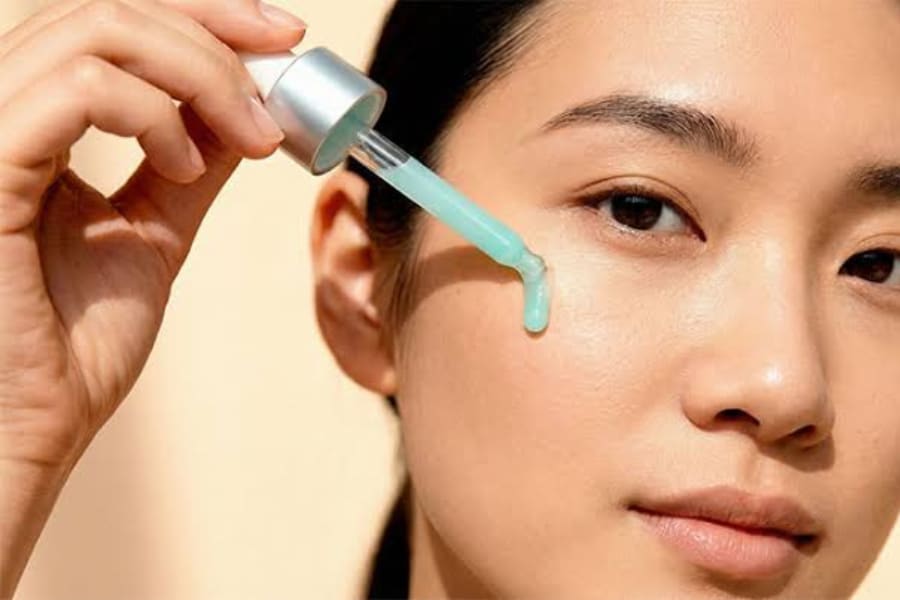
Morning: a gentle, non-stripping cleanser (or water alone, since this area rarely accumulates debris overnight), a vitamin C serum if already part of the regimen, a hydrating eye cream, and sunscreen applied all the way to the lash line without exception.
Evening: cleanse, then apply a low-strength retinoid or a peptide product every second or third night — not both on the same night while tolerance is being established — followed by a richer, ceramide-based eye cream to buffer potential irritation.
Consistency outweighs precision in sequencing. Six weeks of a routine followed four nights per week will outperform a meticulous routine followed for ten days and then abandoned.
The Underappreciated Role of Sunscreen
Comparing two individuals of similar age — one with minimal under-eye lines and one with pronounced lines — sunscreen use is frequently the variable that accounts for the difference: applied daily, reapplied as needed, and brought close enough to the lash line to be effective. Ultraviolet exposure degrades collagen and elastin more rapidly than nearly any other single factor, and because periorbital skin already has minimal structural cushioning, that degradation becomes visible here first. Mineral formulations (zinc oxide or titanium dioxide) are generally better tolerated in this area than chemical sunscreens, which are more likely to cause stinging near the eyes.
When Topical Treatment Is Insufficient: Procedural Options
For lines that do not respond adequately to a topical regimen, a professional tier of treatment exists, and matching the appropriate procedure to the specific line type is more important than selecting the most widely marketed option.
- Microneedling induces collagen production through controlled micro-injury and is effective for fine, crepey texture, typically administered across a series of sessions. A prospective clinical case study using radiofrequency microneedling documented a clear reduction in periorbital wrinkles six months after just two treatment sessions in a 43-year-old patient, with side effects limited to transient erythema and swelling.
- Low-dose neuromodulator injections can soften lines caused by muscular movement, though this is an area where an inexperienced injector risks affecting the smile — provider selection matters as much as the treatment itself.
- Radiofrequency or laser resurfacing addresses deeper structural lines by heating lower skin layers to stimulate collagen remodeling, generally with more downtime than microneedling.
- Under-eye fillers address volume loss and shadowing rather than the lines themselves, and are frequently requested to treat hollowing rather than true lines — a common mismatch between the concern and the intervention.
None of these procedures substitute for a topical routine; they perform best when layered onto habits that are already well established.
Habits That Undermine Progress
Several everyday behaviors erode progress more than is generally recognized. Rubbing or tugging at the eye area — while removing makeup, applying product, or out of habit — imposes repetitive mechanical stress on skin that already has minimal elastic support. Sleeping face-down compresses the same patch of skin against a pillow for hours nightly, contributing to static creasing over years. Omitting sunglasses on bright days encourages squinting, which effectively strengthens the muscle responsible for crow’s feet and under-eye creasing.
No single behavior on this list causes fine lines in isolation. Compounded over months and years, however, they accelerate a process that thin skin and genetic predisposition were already driving.
Realistic Expectations by Timeline
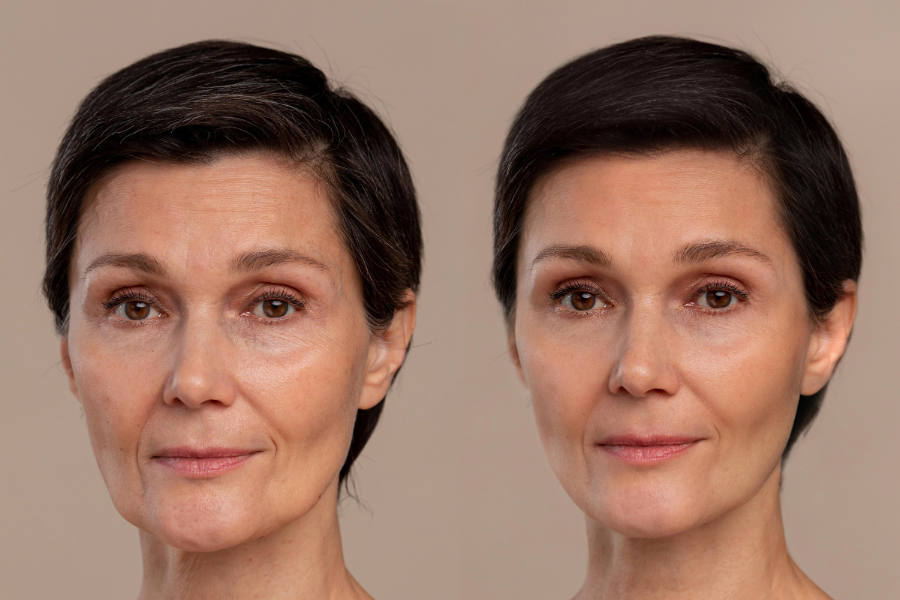
Dehydration-related lines can visibly improve within days of consistent hydrating care. Collagen-dependent improvement from retinoids or peptides takes considerably longer: clinical trial data consistently show measurable change emerging around the six-week mark, with more complete results developing over three to six months as new collagen accumulates. Expecting a serum to resolve a line overnight typically reflects a mismatch between the tool selected and the type of line being treated.
The skin under the eyes was always going to move first. The objective was never to prevent that movement, but to supply the hydration, protection, and collagen support required for it to occur without creasing so readily.
Frequently Asked Questions
Do under-eye patches actually help with fine lines? They provide a short-term hydration boost and can make lines appear temporarily smoother, but the effect fades within hours and they do not build lasting collagen independently.
Can dark circles make fine lines look worse? Yes. Shadowing from dark circles or hollowing exaggerates the appearance of texture and lines nearby, which is why some individuals see greater benefit from addressing volume loss than from targeting the lines directly.
Is it safe to use retinol every night under the eyes? Not for most people initially. This skin is thin enough that nightly use often causes irritation and flaking before delivering benefit, so a gradual increase in frequency is advisable.
Why do fine lines under the eyes appear even in one’s twenties? Genetics, sun exposure, naturally thin periorbital skin, and repetitive expressions such as squinting or smiling can all produce early lines independent of how the rest of the face is aging.
Does drinking more water eliminate under-eye lines? It can assist with dehydration-type lines to a degree, but overall hydration status has a considerably smaller effect than topical moisture and barrier repair applied directly to the skin.
What ingredients should be avoided in eye creams? Heavily fragranced formulas and high concentrations of exfoliating acids are generally poorly tolerated in this area and more likely to cause irritation than improvement.
Can lack of sleep cause fine lines under the eyes? Poor sleep contributes to dehydration and puffiness that can make existing lines more visible, though it functions more as an aggravating factor than a root cause.