
Proprietary ingredients, in-house R&D and patents are pushing India’s beauty industry towards original science.
India has spent decades building a formidable beauty manufacturing and formulation ecosystem. Its next opportunity may lie further upstream: developing the ingredients, technologies and research that give beauty products their performance in the first place.
That transition is already visible in parts of the industry, where companies are investing in proprietary molecules, specialised research and patents rather than relying entirely on established ingredients developed by global suppliers.
Hyderabad-based haircare company Xtovia is one example of this emerging model. The company has secured International Nomenclature of Cosmetic Ingredients (INCI) names for two synthesised molecules, Arginine Thioctate and Stearamidopropyl Dimethylamine Thioctate. INCI is the internationally recognised system used to identify cosmetic ingredients, allowing ingredients to be named consistently on product labels across markets.
For Xtovia, the development is significant because the molecules were synthesised in-house and form part of the technology behind its haircare products. The company says the milestone makes it the first Indian beauty company to secure INCI names for two of its own synthesised molecules.
The development comes as India’s specialty chemicals and beauty sectors increasingly look towards higher-value research and development. The country’s established capabilities in manufacturing and formulation provide a base for this next stage, while advances in scientific research are allowing some companies to build proprietary technologies that can potentially be commercialised beyond their own consumer products.
Xtovia’s founder Navneet Misra has described the company’s approach as part of a wider change in Indian innovation, with companies increasingly looking to develop their own science and intellectual property rather than simply work with existing technologies.
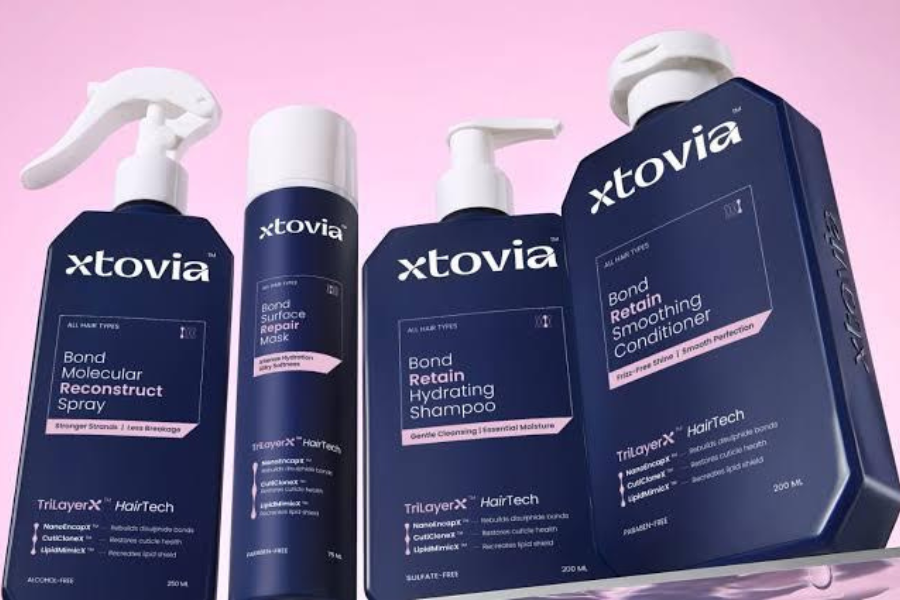
Its research is centred on TriLayerX HairTech, a patent-pending platform designed to address different layers of damaged hair. According to Xtovia, the system combines three technologies: NanoEncapX for the cortex, CutiCloneX for the cuticle and LipidMimicX for the hair’s lipid layer.
CutiCloneX uses Arginine Thioctate, which the company describes as a synthesised molecule developed for damaged cuticles. LipidMimicX incorporates Stearamidopropyl Dimethylamine Thioctate and is designed to recreate the protective lipid layer around the hair. NanoEncapX, meanwhile, uses a proprietary delivery system involving Cyclodextrin and Alpha Lipoic Acid, which Xtovia says is designed to reach the cortex.
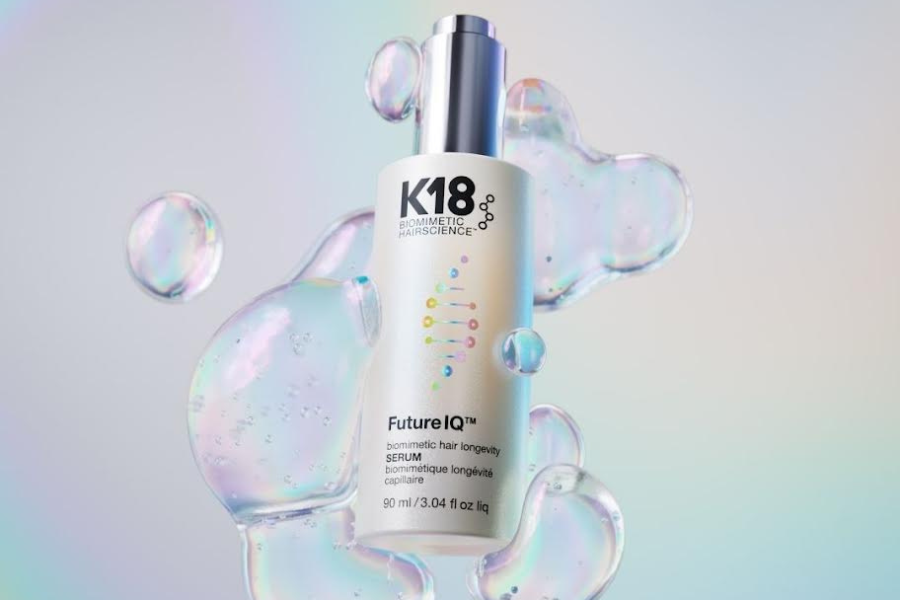
The approach places Xtovia within a broader evolution in premium hair repair. Olaplex helped establish bond-building as a major category in haircare, while K18 brought biomimetic peptide technology into the conversation. Xtovia is positioning its own technology around multiple mechanisms operating across the hair fibre rather than a single repair pathway.
That shift could have implications for how beauty companies build competitive advantage. Proprietary ingredients and technologies can give brands something more defensible than a formulation that can be replicated using widely available raw materials. They can also create opportunities to build patent portfolios, develop specialised testing methods and potentially extend the underlying technology into new products or partnerships.
Xtovia says it has filed five patents, including three global applications, covering technologies developed in-house, with one patent already granted. The company has also developed what it describes as a visual hair-repair test and an Elastometer-based methodology to assess changes in hair strength.
The larger significance lies beyond one haircare brand. If more Indian beauty companies begin investing in original molecules, laboratory research, patents and measurable testing, the country’s role in the global beauty business could gradually expand from making and formulating products to developing the technologies behind them.
Xtovia offers an early example of what that model could look like: a beauty company whose differentiation begins in the laboratory and extends to the finished product.