

Part 1 of 2: A Clinical Guide for Salon Owners and Skin Professionals
Melasma is one of the most common pigmentation concerns walking through salon doors today, and one of the most misunderstood. Clients trust professionals to recognise what they are looking at, explain it clearly, and guide them toward realistic, safe outcomes. This two-part guide breaks the condition down in clinical terms, with plain language explanations alongside, so every team member can speak about melasma with confidence and offer specific, evidence-informed care rather than generic advice.
Melasma presents as symmetrical, well-defined patches of excess pigment concentrated in sun-exposed areas of the face.
What Is Melasma?
Melasma is a chronic, acquired form of hyperpigmentation, skin that has darkened due to excess pigment. It typically appears as symmetrical, well-defined macules across the malar (cheek), forehead, upper lip, nose, and chin, following three dominant patterns: centrofacial, malar, or mandibular.
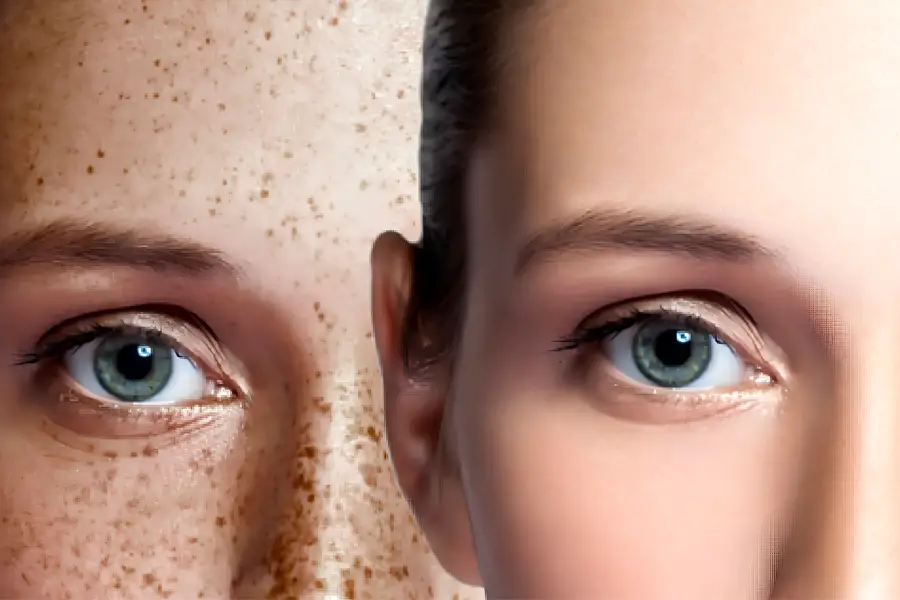
Clients often confuse melasma with freckles, but the two need different counselling. Freckles (ephelides) are small, uniform spots that fade without sun exposure. Melasma is larger, patchier, and driven by a combination of hormonal and UV triggers, not sun exposure alone.


Freckles are small and uniform; melasma is broader, patchier, and driven by different triggers. See image credit below.
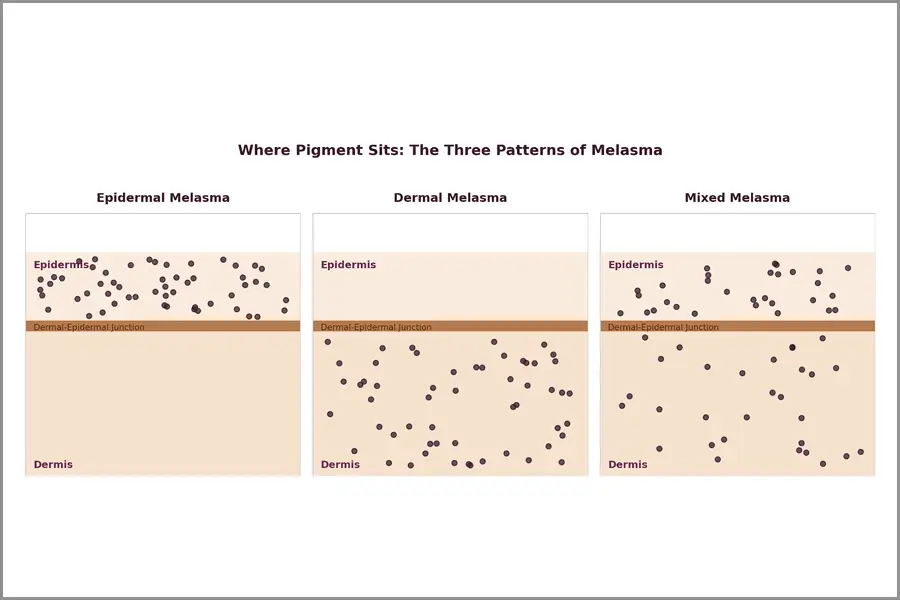
Dermatologists also classify melasma by pigment depth: epidermal (outer layer, responds best to surface treatment), dermal (deeper, more resistant), and mixed (the most common pattern seen in clinic). A Wood’s lamp gives a useful clue at consultation: epidermal pigment looks light brown with enhanced contrast, dermal looks bluish-grey with little contrast change, and mixed looks dark brown with patchy enhancement.
Where pigment sits: epidermal, dermal, and mixed melasma, and how each responds to treatment. Original illustration.
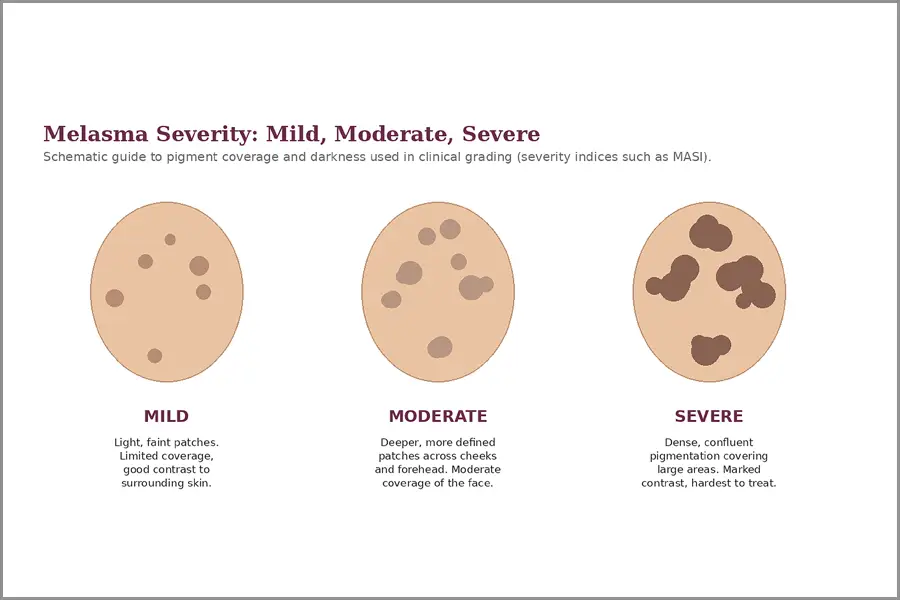
Professionals do not need a formal score to talk about severity, but knowing dermatologists grade melasma as mild, moderate, or severe, based on pigment darkness, homogeneity, and area affected, helps set realistic expectations at the first consultation.
Mild, moderate, and severe melasma, graded by pigment coverage and darkness. Original illustration.
What Happens in the Skin
At the cellular level, overactive melanocytes produce excess melanin, which is transferred to surrounding skin cells through a process called melanogenesis. Newer research shows melasma is not just a melanocyte problem. It involves a two-way conversation between melanocytes and keratinocytes, alongside solar elastosis, a disrupted dermal-epidermal junction that lets pigment leak downward, more mast cells, and increased vascularity. This is why melasma is now considered a photoageing disorder of the skin, not simply a pigment problem, and why dermal and mixed cases resist treatments that only work on the surface.
Why It Happens
Melasma is multifactorial, meaning several triggers usually act together. Ultraviolet and visible light, including blue light from screens, is the single strongest trigger, stimulating melanocytes directly and activating inflammatory signalling. Hormonal influence, oestrogen, progesterone, contraceptives, and hormone replacement therapy, explains why melasma is sometimes called the mask of pregnancy. Genetic predisposition shows up as family history in over 40% of published cases. Heat, aggressive facials, waxing, threading, or laser mishandling can also provoke a flare, and thyroid dysfunction or certain medications are linked to onset too.
Who It Happens To
Melasma is far more common in women, with men making up roughly 10% of cases, and it shows a strong preference for Fitzpatrick skin types III through VI. Clients with medium to deep skin tones in high-sun regions are disproportionately affected, with prevalence ranging from roughly 9% to 40% depending on the population studied.
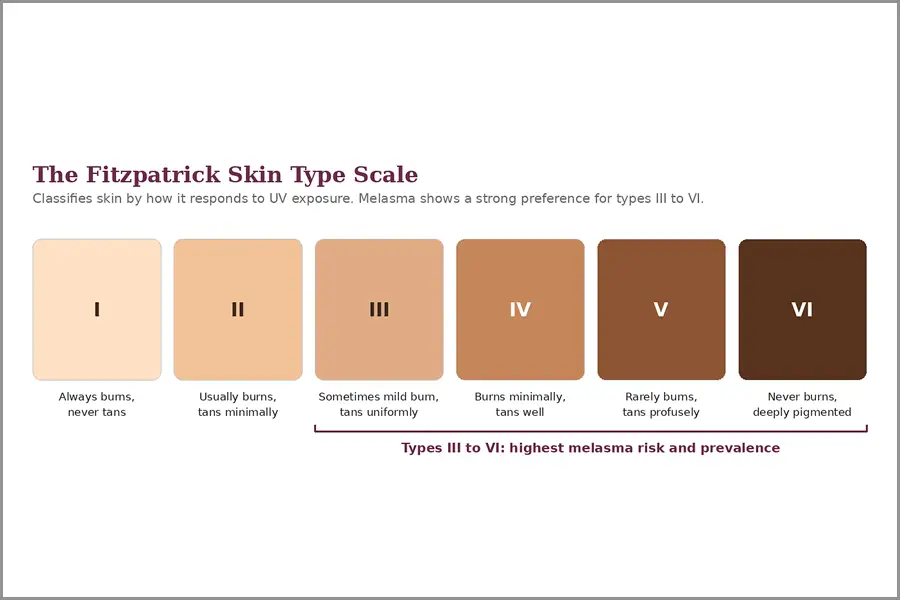
The Fitzpatrick scale, used to classify skin by its response to UV exposure. Melasma shows a strong preference for types III to VI. Original illustration.
It typically presents between the ages of 20 and 40, often triggered by pregnancy, hormonal contraception, or intense sun exposure. Once established, melasma tends to be chronic and relapsing: it fades with treatment and season, then returns with renewed triggers, which is worth setting as an expectation at the very first consultation. Studies also show melasma carries a real emotional toll, close to a third of affected clients report feeling less attractive because of their skin.
The Way Forward
Melasma is manageable, but it is rarely cured in a single sense. The professional goal is control, not permanent eradication. A realistic care plan rests on three pillars working together: strict photoprotection, targeted pigment-reducing treatment, and ongoing maintenance, divided into an intensive phase (the first 8 to 12 weeks) and a maintenance phase (typically 4 to 6 months). Part 2 of this guide turns to the specific salon services, clinic referrals, and training every professional needs to deliver that plan safely.
Image Credit
Freckles photo: Andrea Piacquadio, Pexels. Melasma photo: Dr. Gandikota Raghurama Rao, Wikimedia Commons (CC BY 4.0), cropped to the lower face..