
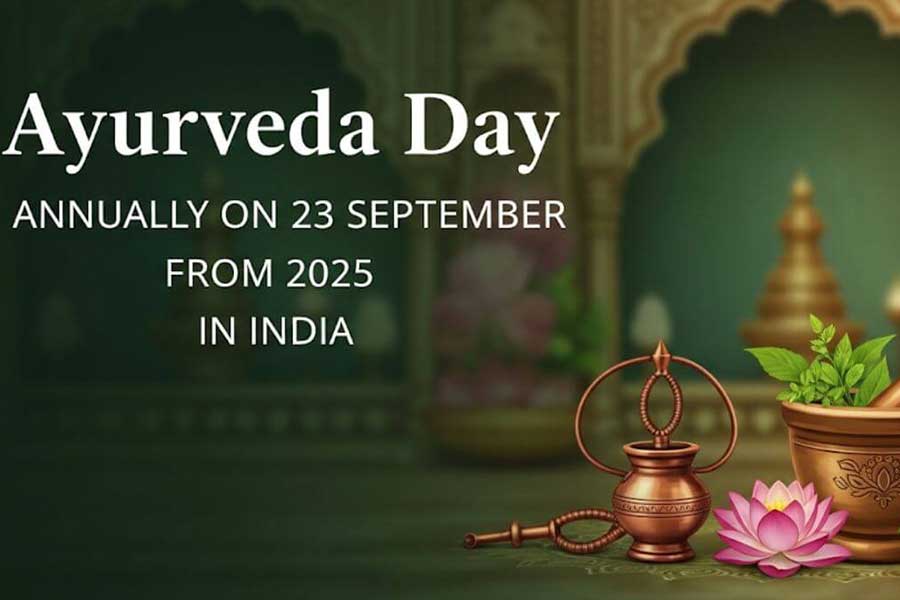

From 2025, Ayurveda Day will be observed annually on September 23, following a government notification issued in March of this year. Until now, the observance was linked to Dhanvantari Jayanti, but the decision to fix a permanent date marks a new chapter in giving Ayurveda a distinct global identity.
The 2025 theme, “Ayurveda for People & Planet,” reflects the system’s emphasis on harmony between human health and the natural environment. Union Minister of State for Ayush, Prataprao Jadhav, noted that Ayurveda should be seen not merely as medicine but as a life science rooted in balance and sustainability. He explained that a fixed date would help ensure wider global recognition and participation.
Since its inception in 2016, Ayurveda Day has steadily grown into a global movement. Vaidya Rajesh Kotecha, Secretary of the Ministry of Ayush, pointed out that Ayurveda is now practised widely in both urban and rural India, a fact supported by national survey data. The new format of celebrations, he added, is intended to deepen Ayurveda’s role in preventive healthcare, holistic wellness, and ecological awareness.
The 2024 observance had already demonstrated this vision on a large scale. Prime Minister Narendra Modi inaugurated Phase II of the All India Institute of Ayurveda in New Delhi, announced four Centres of Excellence, and launched the Desh Ka Prakriti Parikshan Abhiyan alongside other major health initiatives worth nearly ₹12,850 crore. Internationally, events were organised across 150 countries, underscoring Ayurveda’s growing relevance.
For 2025, the Ministry of Ayush has planned a comprehensive set of activities, ranging from public awareness drives and free wellness consultations to student and youth engagement programs. Global partnerships and campaigns are also expected to play a prominent role, further positioning Ayurveda as a modern solution to emerging challenges, including lifestyle-related disorders, stress, and health risks associated with climate change.
By assigning Ayurveda Day a fixed place on the calendar, India is not only strengthening its traditional knowledge systems but also encouraging the world to adopt a more balanced and sustainable approach to health and well-being.